[Disclaimer] As of February 2026, this post is for informational purposes only. I am a tech blogger sharing my analysis of recent events in the Korean crypto market. Always DYOR.
Introduction
Imagine waking up to find thousands of Bitcoins in your exchange account by mistake. On February 6, 2026, this became a reality for hundreds of users on Bithumb, one of South Korea’s largest exchanges. This “Fat Finger” error created massive panic and led to a flash crash in the local market. In this post, I will break down the incident, analyze the public’s reaction, and explain why this was a failure of a centralized system, not the Bitcoin protocol itself.
The Incident: What Happened?
On February 6, 2026, around 7:00 PM (KST), Bithumb attempted to distribute rewards for a promotional “Random Box Event.” However, an employee made a critical error by entering “BTC” as the unit instead of “KRW” (Korean Won).
The Scale: A total of 620,000 BTC was distributed to 695 users. To put this in perspective, this amount is nearly equal to the total Bitcoin holdings of MicroStrategy (approx. 710k BTC).
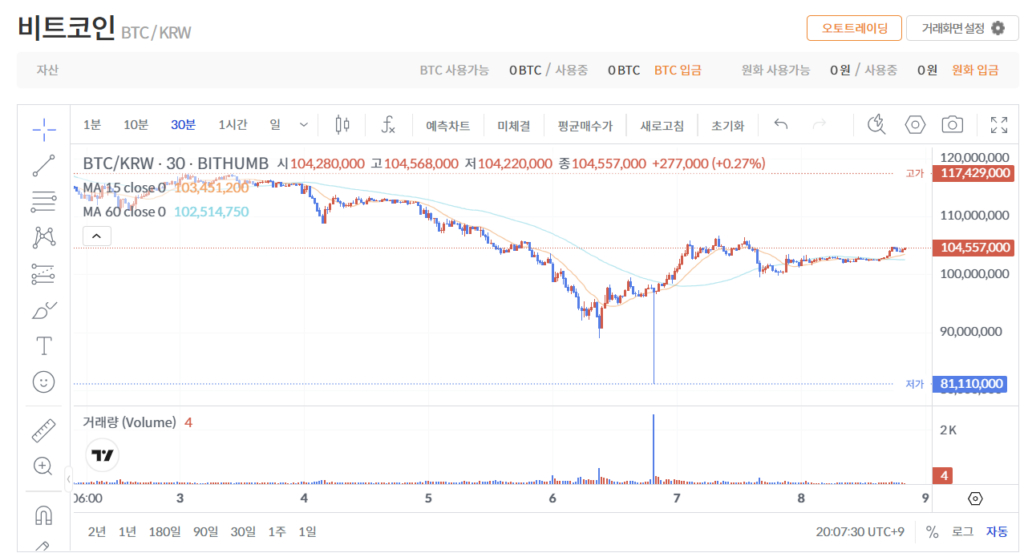
The Market Impact: Upon seeing the massive deposits, some users immediately began selling. This caused Bitcoin’s price on Bithumb to flash-crash to 81.11 million KRW (while the global market remained stable).
The Response: Bithumb immediately suspended all withdrawals and trading to begin a recovery process.
Current Status: Bithumb announced that they have recovered 99.7% of the misallocated coins.
The Reality Check: 3 Major Misconceptions
1. Did Bithumb “print” new Bitcoins? (NO)
What you see on an exchange screen is Off-chain data. It’s just a digital ledger inside the exchange’s private server. The employee didn’t create new Bitcoins on the blockchain; they simply added zeros to a private spreadsheet. The Bitcoin Network (On-chain) remained untouched.
2. Could these “Ghost Bitcoins” be withdrawn? (NO)
Mathematically and physically, it is impossible to withdraw assets that don’t exist on the blockchain.
Mathematical Limit: To move Bitcoin to an external wallet, you need valid UTXOs (Unspent Transaction Outputs) verified by global nodes. No node in the world would validate a transaction that doesn’t exist on the actual blockchain ledger.
Physical Limit: Most exchange assets are kept in Cold Wallets (offline). The damage was limited to the liquidity available in the “Hot Wallets” (online). This is why self-custody is the ultimate defense.
3. Is there a flaw in Bitcoin’s technology? (NO)
This was a failure of a centralized company’s internal controls, not the Bitcoin protocol. Even if Satoshi Nakamoto himself typed “200 million BTC” into Bithumb’s database, the real On-chain supply would remain capped at 21 million.
Voices from the Ground: Public Reaction in Korea
The incident has sparked intense debate in Korea. Here are some top comments from a recent report by MBC (one of Korea’s major broadcasting networks), reflecting the public’s skepticism and misunderstanding:
“It’s not about the money; it’s the fact that they can sell coins that don’t exist.” — A concerned investor (2.1k likes)
“They claim it’s decentralized, but they froze accounts the moment things went wrong. LOL.” — Netizen on the irony of CEX (321 likes)
“If you can create coins with a single keystroke, this is just a Ponzi scheme.” — Commenter confusing CEX ledgers with Blockchain technology (1.2k likes)
The Takeaway: These reactions show a deep distrust of centralized entities. As an engineer, I see this not as a failure of Bitcoin, but as a classic case of database mismanagement.
Historical “Fat Finger” Errors
This isn’t the first time a simple typo has caused financial chaos. History repeats itself whenever internal controls fail:
2018 Samsung Securities (Korea): An employee accidentally issued 2.8 billion “Ghost Shares” to staff instead of paying a 1,000 KRW cash dividend. This incident is the closest parallel to Bithumb, as it involved creating non-existent assets on a private ledger.
2013 Hanmag Securities (Korea): An algorithmic error in option trading led to a loss of $46 million in just 2 minutes, ultimately leading to the firm’s bankruptcy.
2005 Mizuho Securities (Japan): An employee tried to sell 1 share for 610,000 yen but typed 610,000 shares for 1 yen. The company lost approx. 40 billion yen in just 16 minutes.
Conclusion: “Not Your Keys, Not Your Coins”
This incident is a stark reminder. When you leave your assets on an exchange, you are holding a promise, not the actual coin. This is exactly why I advocate for Air-gapped Hardware Wallets. Don’t let a centralized entity’s “Fat Finger” error affect your financial sovereignty.